
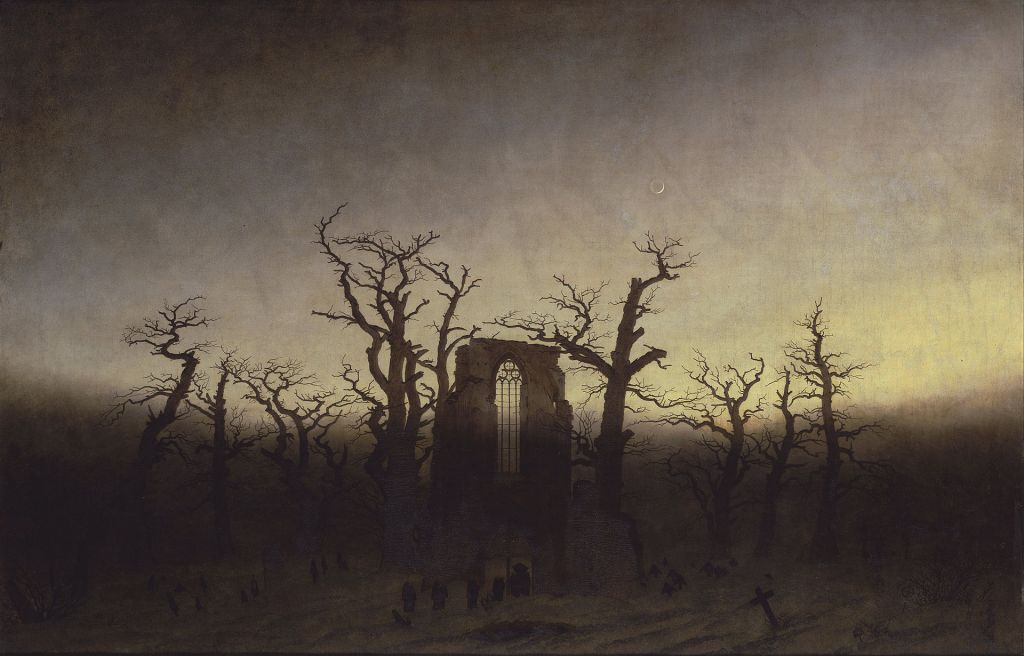
They look as trees
Not merely nude
For autumn’s breeze
But dead and crude,
To ne’er again in color dress
Or lend their shade to the abbess;
Does here the sun no longer shine,
Letting clothes not even to pine?
Has the ground itself gone rot?
But what of God’s stony cot?
What dirt of health is so looted
That even dies what’s not rooted?
Perhaps a curse and not disease
Spelt death for the oak trees,
And drove the clerics far away,
May yet perturb them to this day.
Nay, my fancies about its demise
Are fanciful just as its birth,
Both beheld by eager eyes,
Which see things not upon the earth;
But, why should we wonder so stern
The only thing we ever learn—
That, friary or peasant hut,
All doors someday forever shut?
Though, the abbey as a house of God
Seems time there should never maraud,
But, if ruin becomes the old oak tree
Why not also monastery?
If you please,
God hath made those strong oak trees,
And man the frail monasteries.
Yet, still—we might hope for some permanence,
If only in God’s holy tents;
But time and nature take as same
Both the church and birch in name,
Which surely is not fit for blame,
Nor of man’s spiteful shame;
The only diff’rence twixt in death
Is that the trees once had a breath—
Why mourn thee coffin and not corpse,
Or the plume and not the bird,
As if the hand of man once warps
The dead to life with but a word,
Thinking his spirit does imbue
Whate’er he makes in lively hue?
But, no, his work’s of clay and stone
That no breath of life e’er in blown,
Or unto by the warm sun shown,
Can e’er make life thence unknown.
Grieve not creations of the creature,
Which by fancy have their feature,
As holy books clerics applaud
If, rewritten, describe another god,
Since man be destined death’s grim door,
Why thinks his creatures to endure?
Best to cherish truer fruits
Than man’s sour, rotten disputes;
Best to bypass monast’ries
And, instead, grieve the great oak trees.
-Poyetikos
 Poyetikos